Oxygen Masks
This was a long time ago. Wren was much younger then. There would be other calls after it, other planets, other capsules, and he would forget most of them. Not this one.
Lost Course
First there was silence.
Not the kind you get in an empty room. A different kind. The kind that comes when everything that hummed stops humming at once: the ventilation, the pumps, the nav unit overhead. All that's left is the ringing in your ears, and then that fades too.
The harness held Rada Sen in her seat. The seat was tilted at an angle it should never have been at.
She opened her eyes. The emergency lamps were burning at half strength. In that light, the frost on the viewport looked warm. It wasn't.
"Report," Rada said.
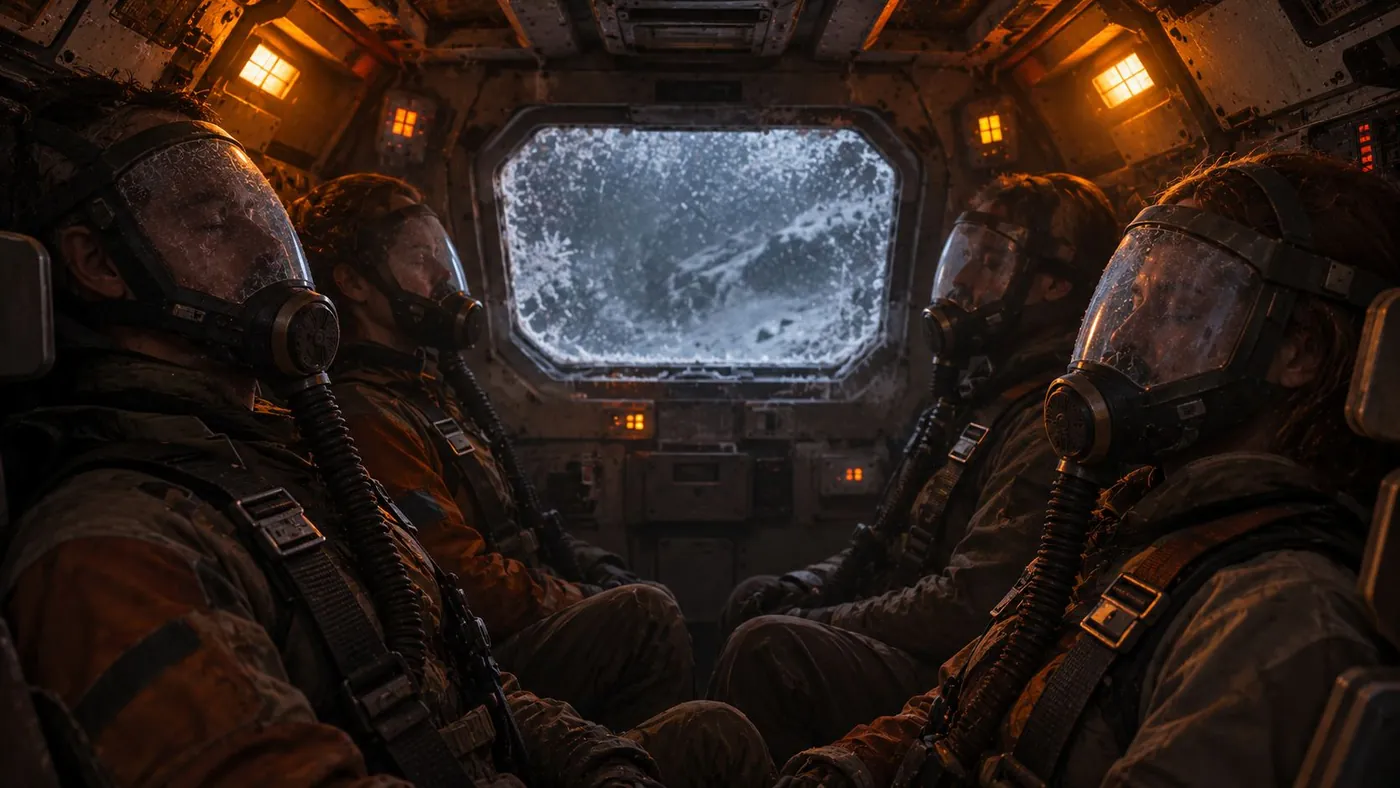
Her voice sounded muffled inside the mask, as if from under a blanket. They had put the masks on during the descent, when the capsule started venting air. Protocol required it.
No one answered. Then, to her right, a buckle clicked.
"Alive," said Mark Il. "I think."
"Yan."
"Here." A pause. "I'm here."
"Sela."
Sela Nur didn't answer right away. Rada turned her head. Sela was sitting hunched forward, her palm pressed to the edge of her mask, right at the cheekbone. Then she lowered her hand.
"Here."
Sela was already unbuckling. She took a penlight from her chest pocket and worked her way around the cabin, holding on to the handrail. She shone it into each visor, checked each pair of pupils. Mark winced. Yan didn't blink, and she shone it at him a second time.
"Yan."
"I'm fine."
"Tell me what day it is."
Yan told her. Sela nodded and moved on.
Somewhere in the cabin, something hissed softly. Rada decided it was the manifold.
Mark had the life-support panel open before Rada could tell him it was time. His gloved fingers wouldn't cooperate, and he had to pull off the right one.
The screen above the panel didn't come on the first time. It flickered, went dark, lit up again.
EMERGENCY OXYGEN RESERVE: 00:38:42.
CABIN TEMPERATURE: MINUS ELEVEN.
PRIMARY CIRCUIT: INOPERATIVE.
Mark looked at the numbers and said nothing. Then he put the glove back on.
"Primary circuit's gone," he said. "Probably damaged on impact. The masks are running off the emergency tanks. The tanks feed a common manifold, and from there each mask has its own regulator."
He tapped the housing under his seat. A small valve stuck out of it, with a white notch.
"Thirty-eight minutes until what?" Rada asked.
"Until the masks stop getting oxygen mix."
"And then?"
Mark didn't answer.
Yan wasn't looking at the screen. He was looking up, at the nav unit. It was dark, except for one red light in the corner. Yan pressed reset. The light went out and came back on. Yan pressed it again.
"I checked," he said. "Twice. The correction was right."
"Later," Rada said.
"We drifted forty degrees. I should have caught it."
"Yan. Later."
He took his hand off the unit. Laid it on his knee. For a while his fingers kept moving, as if they were still pressing.
Rada switched to the emergency frequency. The channel was empty and rough, like sand.
"This is emergency capsule, hull number two. Four people aboard. Hard landing. Primary life support has failed. Oxygen for thirty-eight minutes. Transmitting coordinates by beacon. Over."
Static.
She repeated it. Halfway through the second time, Mark turned toward her, and she realized she was talking too fast. She slowed down.
Static. Then a click.
"Capsule two, I hear you." The voice was male, calm, a little sleepy, like a man who's been woken up but who never really sleeps even when he's asleep. "Rescue service. I have your beacon. Repeat your headcount."
"Four. All conscious. No injuries."
"That's good."
"When will you be here?"
A pause.
"There's a ship nearby. It saw you come down," the voice said. "It can't get to you. You're in a restricted zone, and protocol says no ship lands there. It'll set down outside the perimeter. A rover will drive out to you from there."
"How long is the drive?" Mark asked. Loudly, across the whole cabin, even though the mic was Rada's.
The pause was shorter than the first one. But it was there.
"Passing your information along. Keep the channel open. And save your air: talk less. Out."
Rada let go of the button.
For a few seconds no one in the cabin said anything. Then Yan exhaled. Long, shaky, and for a second the inside of his mask fogged.
"They're coming for us," he said.
"Looks like it," Rada said.
Sela was sitting with the back of her head against the bulkhead. Her eyes were closed. On the strap of her mask, by her temple, there was a strip of white tape with her name. In marker, big letters: NUR. Everyone had labeled their own, so they wouldn't get them mixed up.
Sela's hand was resting at her cheekbone again.
The rescue ship landed outside the zone at twelve minutes past four, universal time.
It landed hard. The wind was hammering the hull, and the landing struts sank deeper into the crust than calculated. The ship rocked, then leveled out. Somewhere in the hold a crate slid loose and hit the wall.
Wren was already below.
He worked without hurrying. Gloves: the old ones, worn through at the palm; the new ones had been sitting in his locker for three months. Map: paper, in the tablet case, folded into squares. Tanks in the medical module: six, all full. He checked the gauge on each one, though they'd been checked recently. Stretcher mounts. Winch hook, cable, lock. Filters. Charge.
He paused on the charge.
OUTSIDE TEMPERATURE: MINUS THIRTY-FIVE.
BATTERY CAPACITY: REDUCED. CAUSE: TEMPERATURE.
The range figure was lower than expected. In cold like this, a battery doesn't give up everything it has.
Wren looked at the number. Then at the map. Then at the number again.
A patch hung from the cab ceiling. Worn, on a cord, left edge down. Wren reached up and straightened it. The patch swayed and slipped back.
"Did you hear the capsule?" his partner asked.
"I heard."
"Thirty-eight minutes. That's what they've got." A rustle of paper. He always worked with paper, even when everything was on screen. "Straight line, it's forty-one kilometers. You won't make it in a straight line. There are ridges. I sent you a route."
"Saw it."
"Wind's picking up."
"Understood."
A pause.
Wren knew the planet from the briefings. Minus thirty-five isn't fatal if you're dressed for it and keep moving. There was air here, but thin. You could breathe it, but it didn't do much good. Anyone can last a minute without a mask. Two, if they don't panic. After that, the brain shuts down before the mind has time to notice.
"Wren," his partner said. "You might not make it."
"I know."
Neither of them said anything else. Wren reached over and turned the cab heat down. Then down again. The needle went almost to the end. The range on the screen went up by half a kilometer.
He pulled his jacket collar up, all the way to his nose. Breathed into it. The fabric went damp right away.
The ramp went down slowly. Wind burst through the gap above it, and snow with it, fine and dry, like salt. Light from the hold fell across the crust. Beyond it, everything was gray.
The rover rocked on the ramp. The wheels caught the ground.
Wren looked at the charge. Looked at the clock.
EMERGENCY BEACON: CAPSULE TWO. BEARING STEADY.
The rover picked up speed.
After a hundred meters, the ship's lights behind him had gone soft. After two hundred, they were gone entirely. What remained was the amber glow of the instruments, the hum of the reactor, and the pulse of the beacon in the speaker. Steady, at even intervals.
The Last Minutes
The cold didn't come all at once. First it was outside, beyond the hull. Then in the bulkheads. Then in the seats.
The frost on the viewports stopped growing. It had nowhere left to grow. Now it grew on the visors.
From the inside, from breath. Every exhale left a thin film on the glass, and the film froze at the edges. First along the bottom edge, by the chin. Then at the sides. The world narrowed to an oval in the middle of the visor.
Yan wiped his with a glove. He couldn't reach the inside, of course. The glass got cleaner on the outside, and that was all.
"Don't touch it," Sela said. "You'll just scratch it."
"I can't see anything."
"It'll get worse. Get used to it."
She spoke evenly, like at a briefing. Her voice was quiet, and with the mask you had to strain to hear it.
"Remember what comes next," she said. "Less oxygen, more carbon dioxide. Your head will feel heavy. You'll want to sleep. Everything will irritate you. Especially the person next to you."
No one else spoke. Talking costs precious oxygen. They'd been told that on the channel, and everyone remembered.
Three sounds were left in the cabin. The hiss of the feed. The rustle of the open channel. And breathing in the masks.
Rada heard her own breathing from inside, through the bones of her skull. Everyone else's she heard with her ears: through the masks and the air. Mark breathed short and fast, like after a run. Yan unevenly: two breaths, a pause, a breath. Sela almost silently.
Rada caught herself counting. Not her own breaths. Theirs. She made herself stop. A minute later she caught herself doing it again.
Mark took the cover off the manifold. Underneath were four lines and the pressure gauge for the common header. The needle was lower than he'd have liked. Then he looked at the screen.
EMERGENCY OXYGEN RESERVE: 00:29:15.
"It's calculating on normal consumption," Mark said. "We're breathing harder than normal. We're scared. So it's less."
"How much less?" Rada asked.
"I don't know. Five minutes. Seven."
"Economy mode."
Mark nodded. He went around the circle, seat to seat, and turned each valve down to the second notch. His own last. The hiss in the cabin grew quieter. The number on the screen blinked and went up.
EMERGENCY OXYGEN RESERVE: 00:41:50.
Yan looked at it and smirked.
"Just like that."
"Not just like that," Sela said. "Breathing's about to get harder. Don't panic. Breathe slowly. Slowly, but not deeply."
It got harder. The air came, but there wasn't much of it, and every breath ended a little sooner than you wanted. As if someone were shutting a door in your face.
Forty-one minutes. Rada held that number in her head, and a second one no one had said out loud. How long the rover would take.
"I can go to minimum," Yan said.
Everyone turned toward him.
"First notch," he said. "Ten minutes or so. I'm young, I can take it. That gives us something, right? Mark, how much would that give us?"
Mark didn't answer.
"I'm the one who lost the course," Yan said. "So I should—"
"No," Rada said.
"Why?"
"Because no."
"That's not an answer."
"It's an order."
Yan looked at her. Through his frozen visor, Rada could see only his eyes.
"No one decides alone, for themselves," Sela said. "Not you, not anyone. If we do something, we do it together. Otherwise there are four of us here, but each one's on their own."
"Beautiful," Mark said.
There was something wrong in his voice. Rada heard it and turned.
"Mark."
"No, really. Beautiful. Together." He stood up. He had to stoop; the ceiling was low. "Together we do what? Breathe in equal shares until it runs out? And then die together? Great. Fair."
"Sit down."
"You're the commander." Mark didn't sit. "So command. Tell us who gets to breathe and who doesn't."
Hiss. The rustle of the channel. Breathing.
Rada looked at him. Then she said, slowly, because there wasn't enough air to say it fast:
"I don't know."
"What?"
"I don't know who'll hold out longer. I'm not a doctor. And Sela won't tell you either. Nobody will. I'm just buying time. Time is all I've got."
Mark stood there. Then he sat. Not because he'd been ordered to, but because standing was hard.
"Fine," he said. "Fine."
The channel clicked.
"Capsule two. Wren."
The voice was different from the one before. Lower. Calmer. Behind it ran a hum, steady and mechanical, and something else, like sand on sheet metal.
"We hear you," Rada said.
"How are your people?"
"All conscious. Economy mode. Screen says forty minutes."
"Copy." A short pause. "Direct route's closed. Ridges. Looks like I'll have to go around to the north."
"How much is that?"
"A bit longer."
Mark reached for the mic. Rada pushed his hand away, and he said loudly:
"Ask him when he'll be here."
Rada didn't want to ask. She asked.
"When will you be here?"
The channel rustled. Sand on sheet metal. The hum.
"I don't know," Wren said. "I can't say exactly."
"Why not?"
"Because I don't know."
Click. He was gone. No goodbye; he just let go of the button.
It got very quiet in the cabin.
Then Yan laughed.
Quietly at first, under his breath, the way people laugh at something they've just remembered. Then louder. He sat with his arms wrapped around himself and laughed, and his mask fogged, and the frost grew at the edges of his visor. The laughter was unnatural. There was nothing funny in it.
"Yan," Rada said.
He kept laughing.
Sela unbuckled and moved over to him, onto the floor, by his seat. She put her hand on his chest, at the center, where the feed line ran.
"Yan. Breathe with me."
"He said," Yan choked, "he said 'I don't know.' He's the only one who... and he said..."
"He told the truth. Breathe with me. In."
Yan breathed in. The laughter broke off in the middle.
"Out. Slowly. Again."
He breathed. Sela kept her hand on his chest and counted out loud, softly, up to four and back down. The laughter didn't come back. After a minute, Yan unclenched his arms.
"That's hypoxia," Sela said.
"I know."
"Good."
EMERGENCY OXYGEN RESERVE: 00:26:08.
The number was dropping faster than it should have been. Mark saw it. Rada saw it too. No one mentioned it.
"Rotation," Rada said.
Mark looked up.
"Three minutes of full feed each," she said. "Everyone else on minimum during that time. Then the next person. Round and round. So no one goes too deep."
"No," Mark said.
"Why?"
"Because if I drift off, there's no one to run the system. The manifold's manual. Who's going to turn the valves, you? You don't know which one is which."
"You'll show me."
"Now?"
"Now."
"Rada." Mark spoke slowly and very distinctly, the way you talk to a child. "The engineer has to stay conscious. I didn't make that up."
"And who makes the decisions? Also me. So I can't go to minimum either. So that leaves Yan and Sela. Right?"
Mark opened his mouth and closed it.
Yan wasn't listening. He was looking at Sela.
She was sitting by his seat, and her face was close, maybe thirty centimeters away. The frost on her visor wasn't like everyone else's. Not uniform, not around the edges. It ran in a stripe, slanting from her right cheekbone. As if wind were blowing in there from inside.
Yan reached out and put his glove on the edge of her mask, at the cheekbone. Right where she had been holding her palm since the landing.
Sela pushed his hand away.
"Sela," Yan said.
She didn't answer.
"What?" Rada asked.
"Her mask," Yan said. "Her mask is leaking. Right here."
Mark turned. Looked at Sela. Then at the manifold. Then at Sela again.
"Since the landing?" he asked.
Sela was silent.
"You've known since the landing." It wasn't even a question. "Half an hour. You've been sitting here half an hour with a leaking mask and you didn't tell us."
"And if I had, then what?"
"Then we'd have..." Mark faltered. He couldn't find the word. "We'd have decided."
"Decided what?" Sela raised her head. "How to split it? It leaks, Mark. The only fix was to cut the feed."
"You had no right. To decide alone. You said it yourself just now... you said it. No one decides alone."
He was right. They all understood that. Sela understood it too.
"And would you have let me?" she said. Her voice cracked, for the first time. "Would you have let me? You didn't let Yan."
The Storm
Past the ridges, the plateau began.
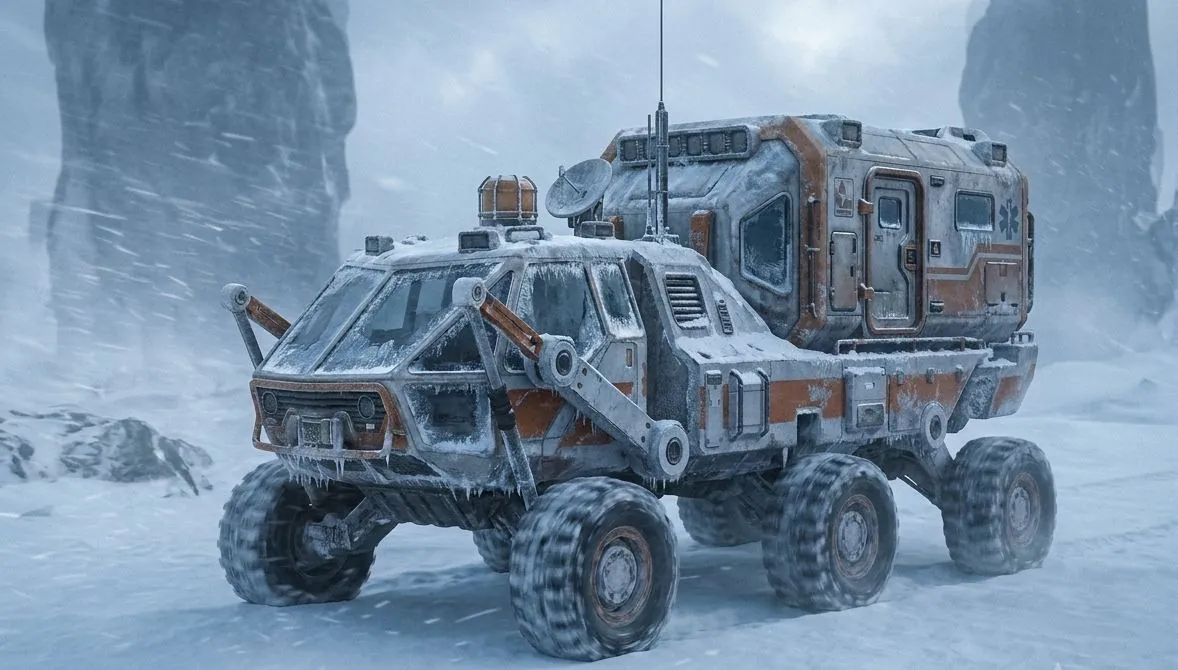
Flat, white, without a single shadow. In daylight it would probably have been blinding. Now there was wind, and it carried a grit of ice across the plateau. The grit moved low, right over the crust, and in the headlights it looked like driving through a river flowing the other way.
It struck the hull. Not tapping, but hissing, dense, without a break. Wren stopped hearing it after five minutes. Then he heard it again, when the wind changed angle and the sound went higher.
He looked at the charge.
RANGE: 38 KM.
Fifteen minutes ago it had been fifty. He'd driven eleven.
The reactor ran steady, on a single note. But half of what it gave wasn't going to the wheels. It was going to the battery, to keep the battery from freezing solid. The battery took the heat and gave current back. Grudgingly.
It was cold in the cab. The heat had been almost at zero since he left. Frost had gathered along the bottom of the windshield and on the metal parts of the steering wheel.
He looked at the charge.
RANGE: 37 KM.
"Wren," his partner called. "How's it going?"
"Driving."
"Capsule's on the line. Quiet over there. They're not saying much."
"Smart of them."
"Under forty minutes left."
"Understood."
Wren drove on the bearing. The beacon beeped in the speaker, steady, a little right of course. He corrected.
Up ahead, beyond the plateau, the ridges rose. He saw them only in breaks. The wind would ease for a second, the grit would settle, and a dark jagged line would stand up along the horizon. Then it would close over again.
The route his partner had plotted ran straight through them. From week-old imagery. The imagery showed a pass. Wren looked for the pass and couldn't find it. Only drifts, tall, with sharp cornices.
He looked further left. There the ridge was lower, and the snow on it lay smooth, without cornices. The wind ran along it there. Which meant it scoured. Which meant the crust would be hard.
He took the paper map out of the case, spread it on his knee, and traced a line with his fingernail. It didn't come out the way it looked on the screen. Then he folded the map and bore left.
In the capsule, the batteries died.
First half the emergency lamps went out. Then the other half flickered, and the screen over the manifold dimmed. The numbers could barely be read.
EMERGENCY OXYGEN RESERVE: 00:17:4...
The last digit blurred.
"Cold," Mark said. "Batteries in the cold. They can't hold."
"What do we need?" Rada asked.
"The manifold. The beacon."
"Everything else?"
Mark looked at her.
"Shut everything else off."
Mark shut it off. Seat heating, which wasn't working anyway. Intercom. Lights.
The screen went last. The numbers didn't vanish at once; first they turned gray, then they were gone. Only frost was left on the glass.
The darkness was total. Then something clicked in it, and a small white circle lit up. Sela's penlight. She held it at her knees, pointed at the floor, and the light spread across the capsule.
Now no one knew how much was left.
Rada caught herself staring at the place where the screen had been. As if the numbers were still there.
Mark stood up. He moved slowly, as if underwater, and at first Rada didn't understand where he was going. Then she did. To the manifold.
"Mark."
He didn't turn. His hand found the cover...
"Mark, what are you doing?"
"Resetting it. It's set wrong. It needs to be different."
"Different how?"
"Different."
Rada stood and grabbed his arm. Above the wrist, hard. He jerked. She didn't let go. He jerked harder and lost his balance. Mark went down sideways, onto the armrest, then onto the floor. Hit his shoulder. His mask knocked against the bulkhead.
Yan jumped up. Together he and Rada lifted Mark by the shoulders and got him into the seat. He didn't resist. He sat holding the armrests, and his breathing was loud.
"Mark," Rada said. "Look at me."
He looked. Through the visor, through the frost.
"I don't know what I was going to do," he said. "No, really. I don't know."
"It's okay, Mark. Sit."
He sat. Yan sat next to him, on the floor. Rada stayed standing, holding the handrail. Her head was heavy.
For a few seconds no one said anything. Everyone breathed. Everyone heard the others breathing.
Then Rada asked:
"Sela. How are you?"
Sela didn't answer.
"Sela!"
"Yes," Sela said. Late. Quietly.
Rada turned. Sela was sitting by her seat, on the floor. The penlight lay in her lap. The light pointed down. Her hands lay still.
"Sela, say something."
Sela raised her head. Slowly. As if it took thought.
"Everything's fine."
Yan stood up. He took the penlight from her lap; Sela didn't resist. He shone it in her face. The frost on her visor ran in a stripe, slanting from the cheekbone. Her eyes were half closed.
Yan moved the light to the manifold, then to the valves, one by one. The notch on the fourth valve was almost at zero, at minimum. Lower than all the others. Lower than Mark had set it.
"Sela," Yan said. "You turned yours down."
Sela didn't answer.
"When? When the lights went out?"
"It's right this way," she said. Barely audible. "My mask leaks. I take more. So I need less. That makes it even."
"Sela..."
Her head tipped forward. Gently, like someone dozing off on a train. Then again. Yan got his hand under her just in time.
She didn't move.
"Sela!"
Mark was first. Rada didn't see him stand up. He was simply at the manifold, and his fingers, which a minute ago wouldn't work, found the fourth valve at once. He opened it up. All the way. Then he found his own and turned it down. To the first notch.
The hiss in the cabin grew louder.
Rada went to the manifold and turned hers down. Not a word.
Yan sat on the floor holding Sela's head in both hands. Holding it steady, so the mask wouldn't slip, so the feed line wouldn't kink. He looked at her and said nothing.
No one asked again who got to breathe.
Rada picked up the mic. Her hands were cold and heavy. She had to press the button twice.
"Wren."
Static.
"Wren. Capsule two calling."
"Wren. I hear you."
"Sela's unconscious." She stopped. She needed to breathe. The breath was short. "We don't know how much longer we can last. The screen's dead. No numbers. We don't know."
The channel rustled. Somewhere far off, she could hear the hum of a heavy machine driving through a snowstorm.
"Wren," Rada said. "Please."
A pause.
"I see your beacon."
Wren let go of the button.
He did see the beacon. Not on the screen; with his eyes. Far ahead, beyond the last ridge, in a gap in the storm, a small amber point was blinking. It blinked, vanished, blinked again. Through the snow it seemed alive.
RANGE: 4 KM.
DISTANCE TO TARGET: 5 KM.
Wren looked at the two lines. Looked at the point of light.
He switched off the headlights. Everything went dark at once, completely, and the point ahead grew brighter. He switched off the windshield heat. Switched off the link to the ship. Switched off the instrument lights, leaving only one line.
What was left was the reactor, humming on a single note, and the bright point ahead.
Wren pulled his collar higher. Gripped the wheel and drove toward the light.
The Last Breath
The last kilometer ran downhill.
The capsule lay in a hollow, and the ridge beyond which the beacon blinked turned out to be its rim. The rover crested it and rolled down on its own, almost without power. Wren held the wheel and left the throttle alone. The number on the one line he'd kept stopped falling. Held. Dropped one more.
RANGE: 0.8 KM.
The beacon was no longer a point. It blinked at head height, on a mast sticking up out of a drift. Beneath the mast lay something long and dark, half buried in snow. The capsule's hull. Nose driven into the crust, stern raised. The frost on it was thick as fur.
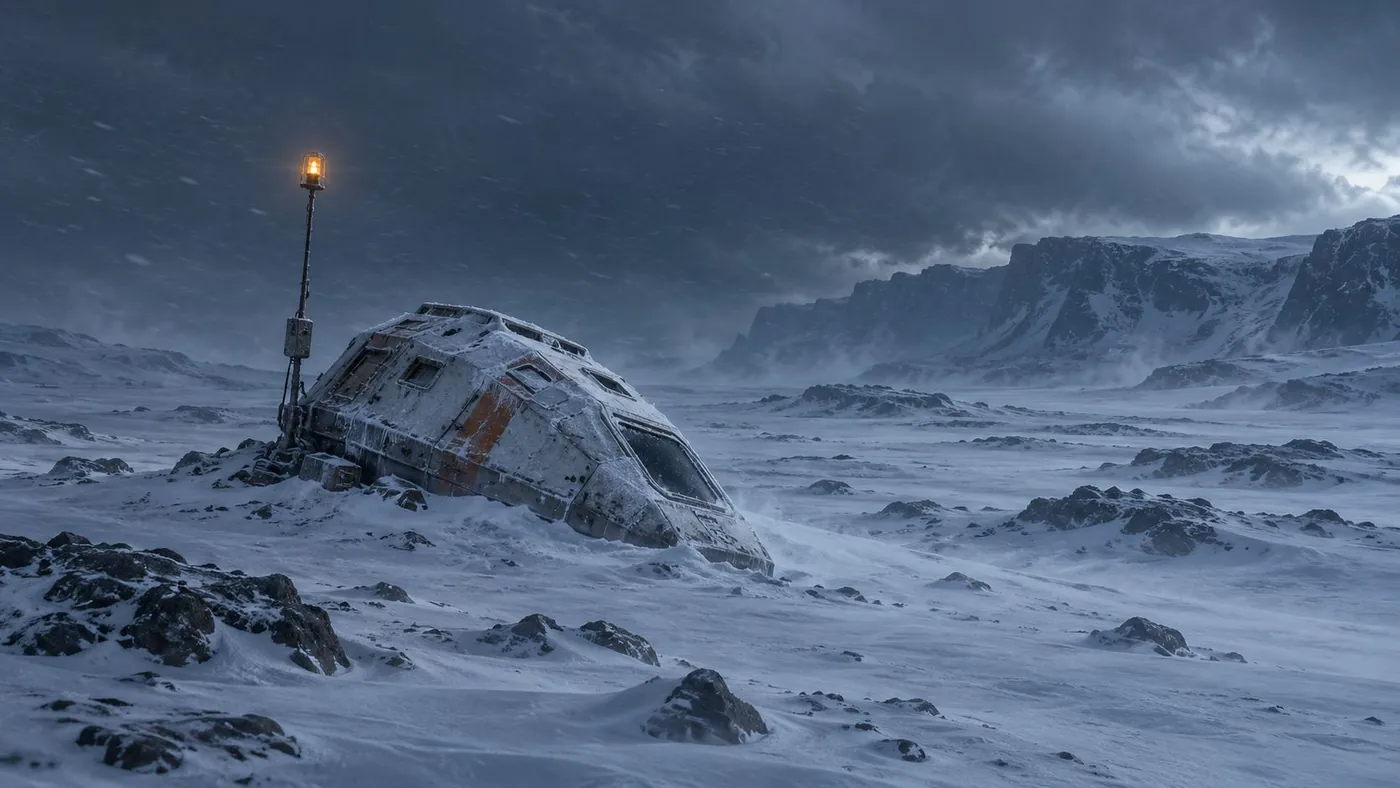
Wren stopped the rover ten meters away.
He unbuckled, put on an oxygen mask, slung the winch hook over his shoulder, took an oxygen tank in his hand, and got out.
The wind hit him from the side. Wren bent low and walked toward the capsule, holding on to the cable that paid out behind him.
The hatch was in the side wall, near the stern. Wren found it by its handhold: the grip stuck out of the frost, the only thing that did. He knocked the frost away with his fist. The hatch was there. But it sat crooked. The hull had twisted on impact, and the hatch frame was warped.
Wren took hold of the emergency release and pulled. It gave a centimeter.
He knocked on the hull. Three times. Waited. Nothing from inside. Wind.
He hooked the winch onto the handhold. Walked back to the rover along the cable, slowly, never letting go.
In the cab he sat down, took the winch lever, and looked at the charge. There was no number anymore. Just a red icon and an empty bar.
Wren started the winch.
The cable went taut. The rover squatted on its rear wheels, then lurched forward, toward the capsule, half a meter. The cable thrummed like a string.
The hatch was jammed.
Wren threw it in reverse. The rover dug in its wheels and pulled on what charge was left. Somewhere in the capsule something cracked. Loud and dry, like ice breaking on a river.
The hatch came open. Not all the way, halfway. It hung on one hinge, so that a person could fit through the gap between it and the frame.
The winch went silent; the reactor cut out. It got very quiet. Only the wind.
Wren looked at the dead panel. Then he got out.
He squeezed through the gap sideways. Inside it was dark. Only a small white circle on the floor. A penlight that had fallen from someone's hands.
Wren picked it up.
Four of them. Motionless, in masks with white visors. White with frost; no faces visible. One in a seat, slumped. One standing, holding the handrail, not moving. Two on the floor.
"Are you alive?" Wren shouted. "Can you hear me?"
The one at the handrail swayed.
"I hear you," she said slowly.
The one in the seat raised a hand. The one on the floor raised his head.
The fourth didn't move.
Wren knelt beside Sela. Yan was holding her head and looking up at him through the frost.
"Is she breathing?" Yan asked. "I can't tell. I can't tell if she's breathing or not."
Wren didn't answer. He pulled off a glove and put his fingers to Sela's neck, under the mask strap. There was no pulse.
He unbuckled her mask. The strap with the tape, with her name. And Wren saw the crack on the right side.
He put the mask from the module on her. Connected it to the tank. Opened the valve all the way.
Sela wasn't breathing.
Rada let go of the handrail. Not all at once. First one hand, then the other. She took a step, a second, and went down on the floor next to Wren. Heavily, the way people fall rather than sit.
"What do I do?" she asked.
"Hold the mask," Wren said. "Tight."
Rada put her palms on the mask.
"Don't let go," Wren said.
He bent over Sela. Unfastened the collar of her suit. Placed his palms on her chest and pressed. One. Two. Again. Slow, even, counting.
The hiss of the feed.
Yan holds her head. Rada presses the mask. Mark in the seat, out of sight; you can only hear him breathing.
Wren pressed. Counted. Pressed again.
Something stirred under his palms. Faint, barely. Wren stopped.
Sela took a breath.
Short. Shallow. Then she breathed out, and the inside of the mask fogged. A small white spot on the plastic.
Then again.
Rada didn't let go of the mask. Her hands were shaking.
"She's breathing," Yan said.
"She's breathing," Wren said.
He wiped his hand on his knee. Looked at Rada.
"Keep holding. Until we move her."
He carried them out in two trips.
Sela first. The tank on a strap over his shoulder, Sela in his arms. A second mask off the same tank went on Rada. The hose was short.
"We'll have to walk close together, and very carefully," Wren said.
Rada took the cable in one hand and held Sela's mask in place with the other.
Yan and Mark stayed in the capsule.
"Wait," Wren said.
The wind hit at once and pulled them away from the cable. Wren walked in small steps, keeping his shoulder against the cable. Rada beside him.
In the module, Wren laid Sela on the lower bunk and switched her mask to the fixed line. Rada sat down on the floor beside her.
Wren took a second tank off the wall and went back out.
Yan was sitting on the capsule floor. Mark in the seat, head on his chest.
"Yan, on the cable, in front," Wren said. "Hold on with both hands. Mark's with me."
Mark walked, but his legs barely moved. Wren held him by the belt of his suit. Up ahead, Yan grabbed the cable hand over hand, stopped, and went on.
Halfway there, Mark stopped. He turned back toward the capsule, toward the beacon above it. He said something, but no one could make it out.
Wren got a firmer grip on him and kept him moving.
At the rover, Yan grabbed the handle and couldn't pull himself up. Wren hauled them both in, laid them down, hooked them up to the line.
Rada was sitting on the floor. Her hand lay on Sela's mask.
He shut the module door. Inside it wasn't as cold as outside: the module had its own power and heat.
Wren sat down in the cab. Dead panel. The patch above the windshield wasn't swaying. It hung still, left edge down.
Wren pressed start.
The reactor clicked. Hummed, low, on a single note. The note slid down and broke off.
He waited. Counted to thirty. Pressed again.
Click. Hum. Quieter than the first time. Break.
Through the bulkhead, from the module, he could hear someone coughing. Yan. Then it went quiet.
Wren put his hand on the panel. Bare palm, no glove. The metal was cold enough to burn. His hand left a dark print on it.
"Come on," he said.
He counted to sixty. Pressed.
Click. Hum. The note went down. Stopped. Hung there. Went up.
Wren didn't breathe.
The note rose to the middle and held. Steady. Without strain. The hum ran through the body of the rover, through the seat, through his hands on the wheel. The patch under the ceiling swayed.
One light came on on the panel. Then a second. Then a line:
REACTOR: RUNNING.
Wren breathed out into his collar and took the reactor to full power, right up to the limit.
Then he turned on the radio.
"Wren," his partner was calling. "Wren, answer. Wren."
"I hear you."
A pause. A long one.
"How many?" his partner asked.
"Four," Wren said. "All alive. One in bad shape."
Static. Something like an exhale. Maybe just interference.
"Heading back," Wren said. "Get the med bay ready."
"Copy."
He let go of the button. Looked at the capsule's beacon: it was still blinking, behind him now, over the empty capsule. Looked at the charge: it was climbing, slowly, one division at a time.
He turned the rover around and started up, in his own tracks, toward the ridge.
When You Can Breathe
First there was light.
White, soft, even. It came from somewhere above.
Sela lay and looked up. Ceiling. White. The walls were white too. Somewhere to the side, a medical monitor beeped softly in time with a heartbeat. Her heartbeat.
She tried to breathe deeper.
Her chest answered with pain. Dull, wide, under the ribs. Sela went still. Waited. Breathed again, carefully, halfway.
She raised a hand to her face. Slowly; the hand was heavy. Found her cheek. Her cheekbone. Her lips. There was no mask.
Then she turned her head.
By the wall, on a chair, sat a man. Not young, but not old either. Unshaven. His eyes were closed, but he wasn't asleep: sleeping people don't sit like that. His right hand rested on his knee, bandaged from wrist to fingers.
Sela had never seen him before, but she knew who he was.
He opened his eyes. Looked at her. Said nothing.
"The others...?" Sela asked. Her voice came out hoarse, not her own.
"Alive."
She closed her eyes.
The monitor beeped. Footsteps passed somewhere beyond the wall, someone laughed, a door closed. Sela lay and listened, and didn't count. Not her own breaths, not anyone else's.
When she opened her eyes again, the chair by the wall was empty.
They came the next day. All three.
Rada came in first. In uniform, but without insignia, her hair pulled back. Yan behind her, with a bag. Mark last. He stopped at the door and went no further.
"Hi," Sela said.
"Hi," Rada said.
Rada was quiet for a moment. Then she took Sela's hand.
"Sela. I wanted to say. Thank you for..."
"Don't."
"No, listen. You were there..."
"Rada." Sela squeezed her fingers. She didn't have much strength, but she squeezed. "Don't. Not to anyone. Not you, not Mark, not Yan. No one there has to apologize for being afraid to die."
She was quiet for a moment.
"Me neither."
Rada didn't answer. She just didn't let go of her hand.
From the door, without looking up, Mark said:
"I still wake up."
Everyone turned to him.
"From the hiss," he said. "The feed. I'm asleep and I think I hear it hissing. I wake up and listen. And it's the ventilation. Or nothing at all."
"It'll pass," Sela said.
"How would you know?"
"I'm a doctor."
Yan took something out of the bag, wrapped in a napkin.
"Here," he said. "For you."
Sela unwrapped it.
A strap. Gray, frayed at the end, with a buckle. On it, near the edge, a strip of tape. On the tape, in marker, big letters: NUR.
"They wrote off the mask," Yan said. "The crack. Straight to scrap. I took this. I thought..."
He didn't finish saying what he thought.
Sela held the strap. The tape had peeled up at one corner. The letters had run a little; the marker was cheap.
"Yan," she said. "You stole government property."
"Written-off property."
"Still stole it."
Yan laughed. Then Rada. Then Mark at the door, briefly, into his fist. Sela laughed too.
And then the laughter ended. It didn't break off; it turned into something else. Rada sat holding Sela's hand, and her shoulders shook. Yan stood at the window, turned away.
Sela held the strap and cried, without being ashamed of it.
Wren came in when it had all gone quiet.
He stood in the doorway. Bandaged hand, service jacket, bags under his eyes. He looked at all four of them. Nodded.
Yan was the first to step toward him.
"You..." He faltered. "You're a hero. You really are. I wanted to say that."
Wren shook his head.
"I'm just a rescuer."
"But..."
"A rescuer," Wren said. And that was all.
He stood a while longer. Looked at the strap in Sela's hands. At the tape with her name. He held his gaze on it, as if memorizing it. Then he turned to the door.
"Matvei."
He stopped.
Sela raised herself on one elbow.
"You might not have made it."
Wren looked at her.
"I might not have."
A pause. Only the beep of the monitor.
"That's something you only find out when you get there," he said.
And he left.
By evening they had all gone. Sela lay and looked out the window. It was large, the whole wall, and beyond it was the night of space. The same as millions of years ago. Black, bottomless, indifferent. Nothing in it had changed. The stars were where they always were.
There was no frost on the glass.
Sela watched. Far off, at the edge of the window, a point of light was moving slowly. A ship. Whose, where to, why, she didn't know. The point moved evenly, unhurried, and after a minute it passed out of sight.
The strap lay on her chest. She held it in her fingers.
Then she breathed in.
Deep. All the way, right down to the pain under her ribs.
The air didn't run out.