
Packet Age: Twenty-Three Years
Listen
For now the story is read by an AI voice. If the project finds support, a professional narrator will read the stories. Support
The Partner
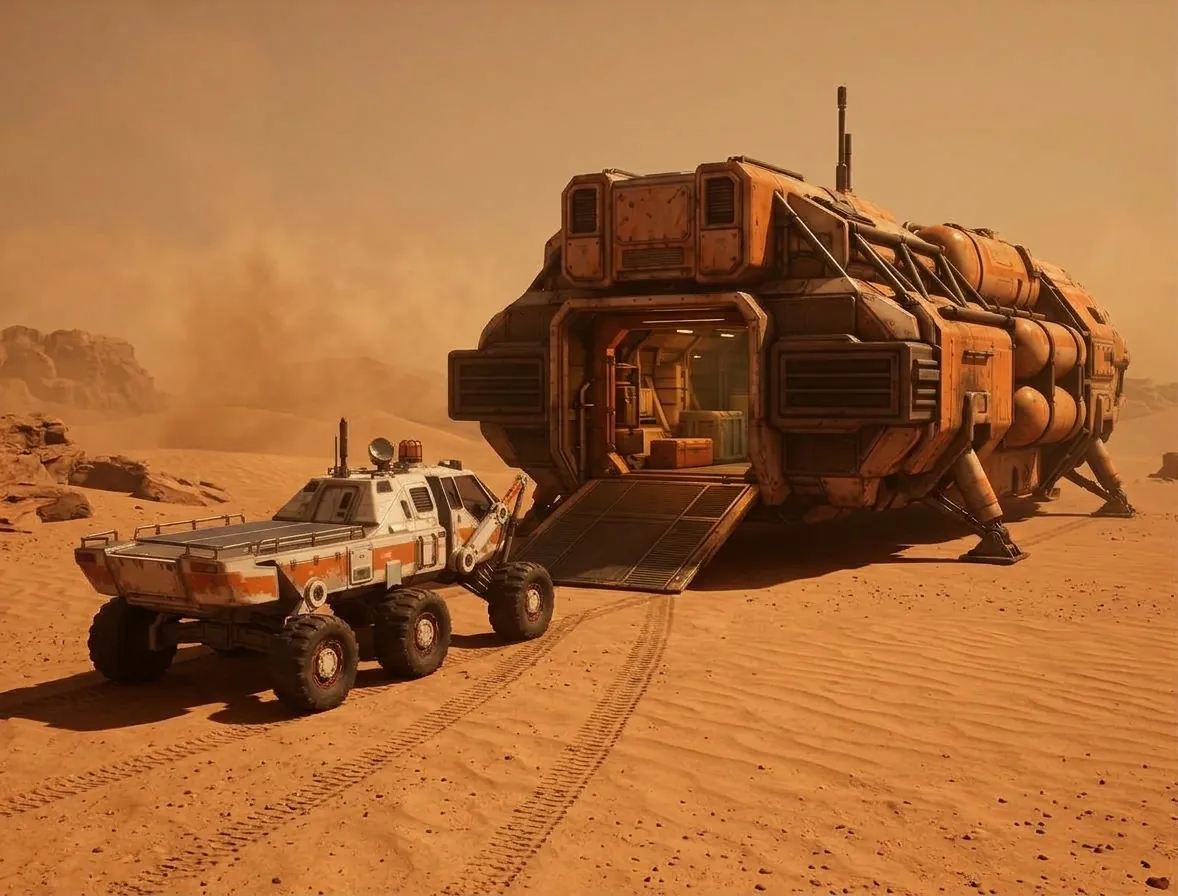
The freighter came in low, turned over the rows and set down on the old concrete by the gate. Dust lifted and ran along the mesh.
Wren sat in Adna's bed with his legs hanging over the side, a map on his knees. He watched closely.
The dispatcher started toward the unexpected guest. He had a list in his hand — he'd just been finishing the inventory. The containers stood by the gate in two rows, numbered to the corporate register.
The ramp came down. A man came down it in a Service jacket with no patch, maybe fifteen years younger than Wren. He stopped and looked over the fence, the rows, the containers.
“Am I even in the right place?”
“Depends what for,” the dispatcher said. “And you are...?”
“Rook. Somebody wrote to me.”
The dispatcher looked at him, then at the list, though it wasn't on the list.
“Wrote?”
“About the calls,” Rook said. “That there's an archive, an intake channel, and people who go out.”
“Yes... Things have changed. It's all closing. The access to the calls too.”
Rook was quiet a moment.
“And the people?”
“I wrote to seven. You're the second. The first one's over there.”
Wren climbed down off the bed, brushed off his palms and came over.
“Wren.”
“Rook.”
“I thought there was a division here.”
“There was,” the dispatcher said, and went off toward the containers.
Rook stood a while, watching him go. Then he turned to Adna and walked a circle around her.
“She run?”
“She runs.”
“And what do you do with her?”
“Nothing, for now,” Wren said.
Rook gave a short laugh with nothing in it.
“Three days I flew.”
“For nothing, as it turns out.”
“I got that already.”
He sat down on the edge of the ramp, elbows on his knees.
At the gate the dispatcher closed a container's doors, checked the number and moved to the next one.
“You got fuel?” Wren asked.
“Enough for one jump.”
“And for a second?”
Rook didn't answer right away.
“I'll find it.”
“Where?”
Wren waited. He could wait a long time, and Rook noticed it.
“All right,” Rook said. “There's money. Not much.”
“Whose?”
Rook looked up at him, and it was plain he didn't want to answer.
“People's,” he said. “I opened a collection. Half a year ago. Announced on the open channels that I'd go out to whatever the corporation is closing, and whoever wants to can chip in for fuel.”
“And they chip in?”
“Two, three units at a time.” He took out a tablet, held it in his hands, but didn't turn the screen around. “Stations, colonies, settlements.”
“Add up to much?”
“No,” Rook said. “And it isn't income.”
He put the tablet away.
“I want back in the Service, but not in the Corporation,” he said. “Half a year collecting, and I haven't taken a single call — I don't know where to get them. And then the letter... and here I am.”
The sun was going down behind the rows. Long shadows from the empty cabs lay across the road.
Wren looked at the trailer by the gate. A light burned in the window.
“There'll be a call,” he said.
“From where?”
Wren didn't answer. He was looking at the window.
The Archive's Last Night
The trailer was cramped: a table, a cot, the intake console against the wall. A sector map hung on the wall, and the dispatcher had already pulled half the pins out of it.
He set three mugs and a kettle on the table.
“The radio's no use to me now,” the dispatcher said. “The other one was with the man at the relay. The one you went out to.”
“Is he there?”
“No.” The dispatcher poured. “They're jamming the relay out. I placed him at the research station on the northern continent, keeper of the comms plant. Antennas, cable, logbooks. There's a colony there, two hundred people, half of them with degrees.”
“He agreed?”
“Thought about it three days. Then asked whether he could live apart from everybody, in the hut by the masts. They allowed it.”
Wren huffed a short laugh.
“He'll be fine, then.”
Rook sat by the door, holding his mug in both hands, looking at the screen.
Two lines burned on the screen. One green, running. The second red, counting down. The digits were large; you could read them from the door.
“What's that?”
“Access revocation,” the dispatcher said. “At midnight they cut the channel. The archive stays, but there'll be nobody to read it and no reason to.”
Rook set his mug down.
“How much is in the archive?”
“Four hundred and something.”
“Four hundred calls?”
“Four hundred records,” the dispatcher said. “Not the same thing.”
He turned the screen toward them. The list ran in small lines, and to the right of every one of them stood the same words: “SEARCH TERMINATED.”
“A call is live for hours,” the dispatcher said. “Days, sometimes, if a man has water and something to breathe. After a week there's usually no point going. Everything lying here has been lying for years. There's no sense driving this list. It's only so that someday somebody can count how many there were.”
Rook looked at the screen.
“And I flew out for this?”
“You flew out for the channel,” the dispatcher said. “There's the channel. While it runs, whatever comes in now drops here.”
“How much drops?”
“Varies. Sometimes three a week, sometimes not one in a month. The sector's empty.”
The screen woke.
“RECEIVED: 03:51. SENDER TIMESTAMP: TWENTY-THREE YEARS AGO.”
Below it: “PACKET AGE: TWENTY-THREE YEARS. SOURCE CANNOT BE DETERMINED. SEARCH TERMINATED.”
Rook leaned toward the screen.
“Sector?”
The dispatcher turned the map.
“Dead. The colony was pulled out of there more than twenty years ago. There's nothing there to transmit.”
“But it's transmitting,” Rook said.
“It's transmitting,” the dispatcher agreed.
Wren set his mug on the table.
“It's running right now?”
The dispatcher checked.
“Running.”
“Then the transmitter is sound,” Wren said. “It's the date that's broken.”
The trailer went quiet. You could hear the water cooling in the kettle.
Rook straightened up.
“We'll take it!”
The dispatcher hesitated, looking at the red digits.
“Your business,” he said, and pushed the radio across to Wren. “Take it, it's no use to me now.”
Wren put the radio in his inside pocket.
“How long is the flight?” he asked.
Rook did the arithmetic in his head.
“A jump. Then a few hours down to orbit.”
“About a day,” Wren reckoned.
“Yes.”
“How close can you set down?” Wren asked.
“Regulation says no closer than fifty kilometers, you ought to remember that. The rest is yours.”
They went out into the dark. The dispatcher stayed at the console.
Wren put Adna's headlights on low, and in that light the rows looked longer than they were.
Until the middle of the night they walked the rows and took everything that might come in useful: they wouldn't be back here soon. Rook turned out to be quick — he went down a row, looked into the power units, pulled high-pressure hose out of the clamps and coiled it in loops like rope. Wren took other things: relays, a coil of cable, suspension parts.
In the eighth row Rook found a good joint assembly and held it up in the headlights.
“Same as her front one?”
“A little smaller.”
“Take it?”
“Yes.”
They pulled a second one off the machine beside it.
When they came back to the gate there was a mound of iron in the bed. Wren covered it with a tarp and lashed it down crosswise with cable.
Rook sat on the ramp step and looked at the mound.
“Half of that will never be needed.”
“Probably,” Wren said. “But you don't know which half in advance.”
Rook thought about it and nodded.
The light in the trailer went out. It was close to midnight.
The Passenger
Adna went into the hold without hurrying. The clearance over the cab came to no more than a palm's width.
Wren shut the reactor down slowly, step by step, listening to every tone. Rook waited at the ramp, then couldn't stand it and climbed up, tightened the tie-downs on the rear axle himself. Tightened them right. Wren looked and said nothing.
He sat the jump out in silence, strapped into the seat, hands on his knees.
He had driven for many years. A passenger he had only ever been on whatever ship happened to be going his way.
“You're not sleeping,” Rook said.
“No.”
“Everybody sleeps through the jump.”
“I'm used to looking ahead,” Wren said.
Rook smirked and left him alone after that.
A few hours later the planet came up: a flat rust-colored surface, two ridges, a dry channel running north to south like a crack in glass.
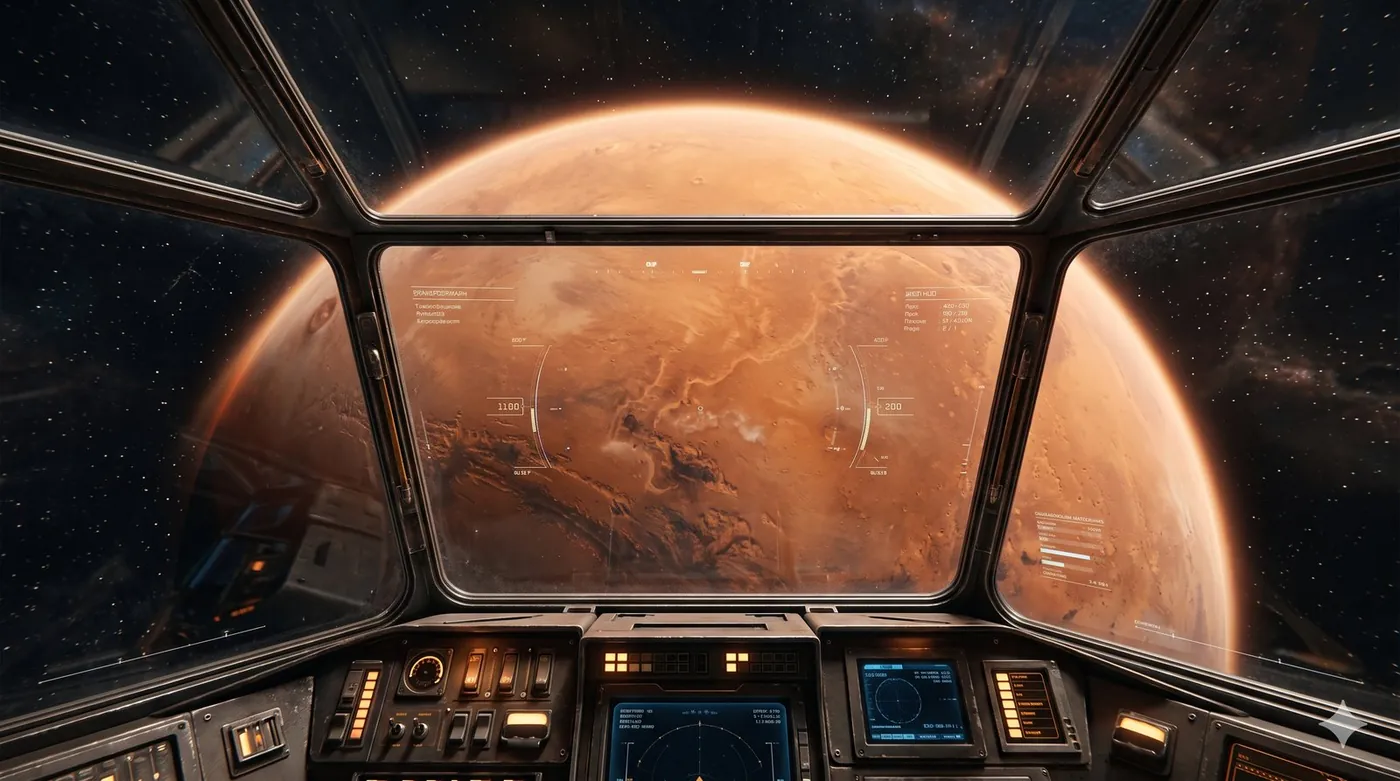
“One corridor,” Rook said, jabbing at the map. “Right here. There's an abandoned unloading pad, built for the colony pullout. And your sixty-five kilometers to the target.”
“Over what?”
“Along the channel. Best there is.”
Wren looked at the gray square.
“We need a callsign,” Rook said.
“What for?”
“I have to call you something. ‘Hey, rover' sounds stupid on air.”
Wren was quiet a moment.
“Relic.”
Rook turned.
“Who came up with that?”
“An old man. At the relay.”
“Sounds like an insult.”
“Depends how you look at it,” Wren said.
Rook thought it over, said into the mic under his breath: “Relic, how do you copy.” It came out short. He nodded.
“And the machine?”
“Adna. Ariadne is the full name.”
Rook looked at him with interest, but didn't take it further.
A ridge went past below, and the screen on Adna's dash — she stood in the hold with her battery live — flickered on the monitor camera.
“MATTHEW WREN. EXTERNAL PRESSURE: RISING. TRANSPORT MODE: YES.”
“What's that?” Rook asked.
“A unit off the rover.”
“It talks?”
“It counts.”
“It uses your full name, all official,” Rook said. “Nothing on my ship does that.”
Rook laughed, the first time in two days.
“What's the unit's name?”
“It doesn't have one.”
“Your machine has a name and this one doesn't?”
“This one counts,” Wren said. “Adds, subtracts, puts it on the screen. An adder.”
He said it dryly, the way people speak of an unpleasant habit.
The landing came out hard: the concrete was old and ran in waves, and the ship settled canted onto its left strut.
Outside it was bright and quiet. The air came dry, with dust and a taste of iron on the tongue. Wren stood at the ramp a while, breathing, then went to undo the straps.
Adna came down the ramp slowly, unfolding her legs one at a time. On the turn the right front joint squealed, shrill and dry. Wren heard it.
Rook brought a canister and set it down beside the rover.
“That's water,” he said. “You don't have enough anyway.”
“I have enough.”
“Enough for you.”
Wren looked at him, and at the canister, but didn't argue.
“How long do I wait?” Rook asked.
“Two, three hours out.”
“And back?”
“Depends.”
Rook stood there. Then he slapped her side with his palm, the way you lay a hand on a horse's neck, and went up into the ship's cabin.
“Relic,” he said. “How do you copy?”
Wren got behind the wheel, opened the channel and pulled the radio over to him.
“I hear you.”
The joints twitched, the magnets woke. Adna turned on the concrete, rolled over the edge of the slab and went down toward the channel.
An amber line lit on the screen.
“BEARING: ACQUIRED. BEACON RUNNING.”
The Road by Ear
The channel was fairly even, like a road nobody built.
For the first kilometers Adna held a good pace. The ground was firm, and old track marks turned up in it. The beacon was running.
It came through the speaker as a steady tone, and it gave direction: drift a little right and the tone goes dull, come back and it gets louder. Wren drove by the sound and looked at the screen rarely.
An hour later the screen flickered.
“BEARING: TWO SOURCES. IDENTICAL.”
“Where's the second?”
“LEFT. ANGLE: THIRTY.”
Wren listened. On the left there really was a tone like it, the same strength.
“Reflection?”
“NOTHING TO REFLECT FROM. HORIZON EMPTY.”
He drove on a little. The second source moved along with him.
Then the instruments went mad.
First the pressure: the column dropped a third and came back. Then the compass, which lied on this planet anyway, began to turn smoothly, in a circle, sliding off degree by degree. Then the odometer showed that Adna had covered nine kilometers in a minute.
Wren looked at it, then at the ground going past the glass at walking pace.
“Arithmometer.”
“COUNTING.”
“Faster.”
“READINGS DISAGREE.”
They went on like that for about another hour. The tone in the speaker didn't change, and it was the only thing worth believing. Once Wren caught himself driving with his shoulders down and his head tipped to one side, the way people listen in the dark.
“How do you copy?” the radio said in Rook's voice, through the crackle.
“I hear you.”
“My instruments are having a party. Altimeter showed minus two hundred.”
“Mine too.”
“You ever had this before?”
“No,” Wren said.
Rook was quiet a moment.
“Go careful out there.”
The screen put up a line on its own, unasked:
“THE NUMBERS ARE DRIFTING. AND SO ARE WE.”
Wren raised his head.
The line hung there steady, amber, like all the rest. He read it twice.
“What was that?”
“OUTPUT ERROR.”
“That's what I figured,” Wren said.
Something in the cab had changed. Before, it had been a device, a piece of hardware, and now it was as though somebody alive were sitting in the dash and not liking it much.
The rock lay alone in the channel, drifted over on the windward side.
Wren didn't see it.
He was listening to the tone, which had just begun sliding right, and steering to it. The wheel of the right front leg hit the rock at full speed.
Adna was thrown up and slammed back down. Wren cut the speed and stopped.
It went quiet. Only the reactor hummed, steady, without strain.
He got out. Crouched at the front leg, put the light on it.
The joint looked whole, but it turned stiff, and the squeal wasn't the old one now — it was a crunch, short, in one spot. Wren took hold of the leg with both hands and rocked it. The crunch came again.
He went back to the cab.
“What do you say?”
“RIGHT FRONT: DAMAGED. ON FIVE WE CAN GO. ADVISE WE GO SLOW.”
Wren read it again. Go. Slow.
He remembered what he had called it. Arithmometer. Rhymeometer, hell.
“We'll go on five.”
He took the load off the right leg, raised it a third of the way and locked it. Adna went with a list to starboard, slow, rolling, and at every bump something clicked quietly in the cab.
“Just a bit more, old girl.”
The joint answered with a crunch.
The tone in the speaker got louder, and the second source on the left went away by itself, as if somebody had switched it off.
“ONE SOURCE. RANGE: CLOSE.”
He turned on the headlights.
Ahead, where the channel ran out, stood a mast with no dishes, two low buildings with no roofs, and a concrete cube with a hatch. There was no light in the windows.
Under the mast a beacon blinked.
Wren stopped Adna twenty meters off and sat a while, looking at it.
“Rook.”
The air took a moment to answer.
“Here.”
“I'm at the target.”
“What's there?”
“A station. Beacon running.” Wren opened the door. “Stay on.”
He took a flashlight and walked to the hatch.
Four Days
The hatch was sunk into the concrete, a handwheel in the middle. Dust lay around the handwheel.
Wren crouched and shone the light. Along the rim of the cover ran a fresh band of clean metal: the hatch had been opened and closed not long ago, and the edge was bright.
He knocked on the cover with the flashlight. Three times, a pause, three more.
Inside it was quiet. Then the handwheel moved.
The cover lifted and warm air came up at him, smelling of porridge and scorched insulation. A man showed in the hatch, young, in coveralls, a flashlight in his hand and the face of somebody who had been expecting to see something else entirely.
“Alone?” he asked.
“Alone,” Wren said.
“And the ship?”
“Not far.”
The man moved the light past him, onto Adna, standing with her list to starboard.
“What's that?”
“Mine.”
The rest were already climbing up behind him. Six in all. Three men, two women, and one of them barely twenty. They came out on top, squinted, looked around at the station, the mast, the empty buildings, and the look on them wasn't the look of people rescued but of people coming out of a cellar after a long confinement.
“Finally,” said the older woman. “Fifth day.”
“Fourth,” the first one corrected her.
“Right, fourth,” she agreed.
Wren stood and listened.
“What happened to you?”
“You don't know?” the first one said, surprised. “We were transmitting.”
“No. I don't have the details.”
He told it. He spoke fast and willingly, like a man who had been holding it in his head for days and was only waiting for somebody to tell it to.
Tuesday night everything stopped at once. Didn't burn out, didn't blow — stopped. Lights, comms, pumps, ventilation, instruments. The clocks on the wall all stopped in the same moment, and the wristwatches too. Then, after a while, some of the light came back on its own, and the comms didn't.
“Somebody saw a strange glow right before it,” he said, “but nearly all of us were below just then.”
“Who turned the beacon on?”
“It did itself. It's on separate power. We haven't touched it since.”
Wren nodded.
He listened, and he looked.
The man in coveralls wore the patch of a colony that had been taken off this planet years ago. The flashlight in his hand had an incandescent bulb and a hand crank, scraped down one side but whole. Behind him in the hatch a ladder showed, and a panel, and on the panel were knife switches Wren hadn't seen since he was young, and even then they were counted old.
And the panel was new. Painted, no rust.
Wren walked around the concrete cube and put the light on the plate at the foot of the mast. Station number, year of construction. He did the arithmetic.
Then he came back to the people.
“Excuse me,” he said. “What's today?”
“Friday,” the woman said. “The fifteenth.”
“The fifteenth,” Wren repeated.
“That's right.”
“And the year?”
They all went quiet.
The young one laughed first. Then the others laughed, not unkindly but with relief, the way people laugh when somebody does something silly and takes the tension off.
She said the year. Wren stood there.
“Understood,” he said.
Then he turned and walked to Adna without a word.
“Where are you going?”
“To get the canopy up,” he said without turning. “You won't all fit in the cab.”
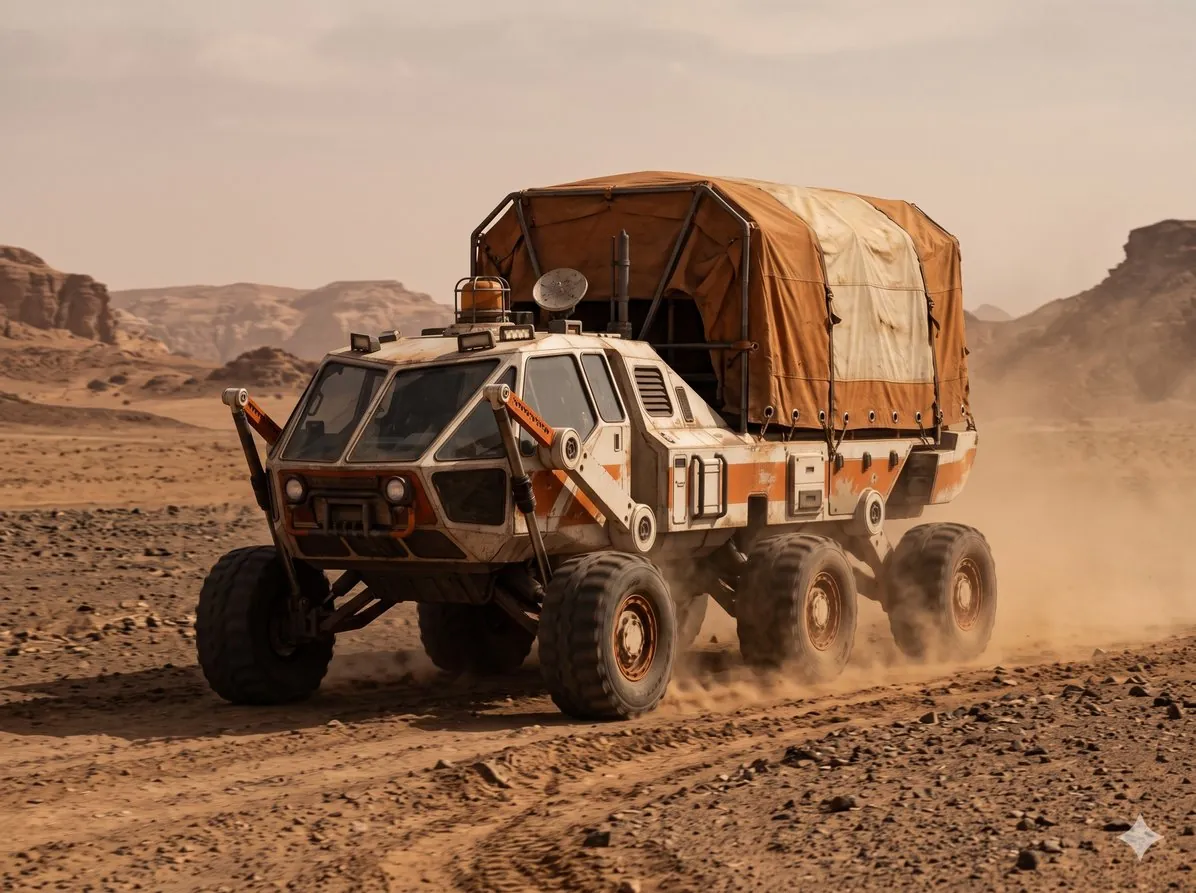
The canopy in the bed was rolled and strapped to the sides. Wren let the straps go, took out the bows, set the first one, went for the second. He set the bows, pulled the fabric tight, walked around, checked the fastenings.
The radio on his belt clicked.
“Relic, how do you copy? What's there?”
Wren took the radio off and held it in his hand.
“There are people,” he said. “Six. All alive.”
“Six?” Rook's voice jumped. “Alive?”
“Yes... after a few days,” Wren said. “That's how they count it.”
“Meaning?”
“We'll sort it out later.”
Wren watched the six of them look his machine over. The young one put up a hand and ran it along the orange stripe on her side, where it had faded to yellow. He turned to his people and said something. They laughed.
“Rook,” Wren said. “Make room for six.”
“Copy. What else should I get ready?”
Wren was silent longer than he needed to be.
“I'll tell you on the way in,” he said, and put the radio away.
He went back to the hatch. The six were hauling their things up: bags, two crates, rolled blankets. The man in coveralls carried a potted plant out of the hatch, a low one with thick leaves, and set it on the concrete to free his hands.
“That comes with us,” he said, catching the look.
“It comes with us,” Wren agreed.
He picked up the pot and carried it to the rover first.
How to Say It
They set out at dusk.
Five rode in the bed under the canopy, on the crates and the rolled blankets, backs to the side panels. The pot stood between its owner's feet.
The sixth sat in the cab, on the right. The one in the coveralls. His name was Sava.
“I went up first, so I ride,” he said, settling in. “Three days they had to listen to me down there.”
Adna went off listing, slow, rolling along on five limbs.
For the first kilometers Sava was quiet, looking through the glass. Then he started.
“We've been through it, I'll say that much.” He rubbed his palms on his knees. “Don't think we panicked. But four days in a tin can with one hot plate, that's something.”
“I believe it.”
“There was water, there was food, we pumped the air by hand. The worst of it was the silence. No comms, no radio.”
Wren drove.
“I can just picture the uproar over there right now,” Sava said. “My wife's at Central. She's filed a report by now, guaranteed. That's how she is: if I'm off the air a day, she goes and files.”
“TO SHIP: FAR. PACE: BELOW NOMINAL.”
“What's it writing?”
“Counting distance.”
“Ah,” Sava said. “Let it count.”
He looked at the screen with respect and went on.
“Marinka took it hardest.” He nodded back toward the canopy. “The older one. Her parents are on the Second Ridge, really old by now. Her father's seventy-two. She says he takes his blood pressure every morning and writes it in a notebook.”
Wren held the wheel and said nothing.
“And Timka, the young one, he just finds it funny,” Sava said. “He's got leave in a week. Bought the ticket, can you imagine. Paid for. It's all gone now, of course, but he's holding up.”
“Grisha's got a son.” Sava pointed back without looking. “The one with the flower. His boy's eight. And his birthday's in —” he counted on his fingers “— in four days, if today's the fifteenth. He'll be nine. He ordered the present, the present's lying at the depot, and here we are sitting in a bunker. He was counting the days to make it.”
Wren looked ahead. Eight plus twenty-three, he thought.
“He'll make it,” Sava said. “You pulled us out, after all. How long is the flight to Central?”
“Ask the pilot.”
“And what are you?”
“I'm not with the Service.”
Sava turned to him.
“Meaning?”
“Meaning what I said.”
“Then who came out for us?”
“I did.”
Sava thought about that and seemed to decide not to dig.
“Well, the main thing is somebody came.”
After that he talked more. About the station chief who had stayed at Central and would catch it now. About how they'd put in a request to fix the panel two months ago and nobody came, and now they'd come all right. About how the first thing he'd do when he got back was go to the bathhouse.
Wren listened and added it up in his head.
Father, seventy-two. Add twenty-three.
Boy, eight. Add twenty-three.
Wife filed a report. Twenty-three years ago.
He tried to start twice.
The first time was when Sava stopped to drink. Wren opened his mouth and said:
“Listen.”
“Yeah?”
“Hold on tight, there's a hole here...”
The second time was an hour later, in the dark, when the headlights picked the hulk of a loader out of the channel, sunk into the ground to the axle, rusted through, its cab fallen to pieces.
“What's that?” Sava said. “Where did that come from?”
Wren slowed.
The loader was old. Not three days, not three years. It had stood there so long that the ground had risen and gone around it on both sides.
“Abandoned,” Wren said.
“I can see it's abandoned. Looks like it's been there a hundred years.”
“Happens.”
“We drove this channel last month,” Sava said. “There was nothing here.”
Wren opened his mouth to say it, and stopped.
Sava was turned around in his seat looking at the loader, smiling in puzzlement, the way people smile at an oddity that has no explanation.
“All right,” he said, and sat back straight. “Who knows.”
Wren shut his mouth and picked up speed.
“MATTHEW WREN.”
Wren cut his eyes to the screen.
“YOU ARE DRIVING WORSE THAN USUAL.”
“I know,” Wren said.
“What?” Sava asked.
“Nothing.”
The Glow
Timka saw it first.
He banged his palm on the cab roof, then again, insistently. Wren slowed and put the window down.
“Something's burning out there,” Timka said from above. “On the right.”
Wren looked.
Above the horizon, low, two or three kilometers out, a light was moving.
It didn't stand still. It went along the ridge, evenly, without jerks, at about a man's height above the ground. From that far off it looked like a column of vehicles with their headlights on, coming over broken country.
Wren stopped Adna and switched his own headlights off.
Without the headlights it showed better. There wasn't one light. There were many, dozens, spheres the size of a cab, gathered in a loose cluster, and they moved slowly inside that cluster relative to one another, like fish in a school. The light was cold, nearer to white, and it lit nothing around itself.
There was no sound.
The cab went quiet, and Wren realized the reactor had begun going quiet too. It hadn't stopped. It had gone softer.
The screen lit all at once.
“BEARING: EVERYWHERE.”
“PRESSURE: NO VALUE.”
“MATTHEW WREN. I DO NOT KNOW WHAT IS HAPPENING.”
Wren put his palm on the screen.
“Write less.”
The needle on the one mechanical instrument he had left running — the loop pressure gauge — went down slowly and came up against zero. Then just as slowly it came back.
Sava looked through the glass. He wasn't talking anymore.
“I think that's it,” he said quietly.
Wren turned to him.
“What?”
“It came then too...” Sava didn't take his eyes off the light.
“Everything stopped while it was there?”
“While it was there.” Sava swallowed. “We went down, dogged the hatch. Sat and listened to nothing working.”
Wren watched the cluster.
It moved. Slowly, on its own business, along the ridge.
He worked out the course. If Adna kept on as she was, their paths would cross soon.
“Hold on,” he said out the window.
Then he took the lever. The drives were running.
Adna turned in place, heavily, with a crunch in the right front, and went left, away from the ridge, up the loose slope of the channel, off the route. The ground slid under the wheels and the machine was dragged sideways. Wren held her.
He took her away until the light went past the edge of the glass, and then further, until it was gone altogether.
The screen was a long time settling.
“PRESSURE: PRESENT.”
“RANGE TO OBJECT: INCREASING. GOOD THAT IT IS INCREASING.”
“Agreed,” Wren said.
He took her further right, to the far side of the channel, and added what speed the raised leg allowed.
Sava sat gripping the handhold.
“Do you know what that is?” he asked.
“No.”
“Who does?”
“Nobody,” Wren said. “This sector's been closed twenty years. People don't come here.”
“Twenty years?”
Wren realized he'd said too much.
Sava thought.
“You said twenty years,” he repeated.
Wren drove without answering.
Behind them under the canopy it was quiet. They drove a long time more, and Sava asked nothing else.
Before long the ship showed in the distance. It stood on the slab with the ramp down. Rook was walking around at the bottom of the ramp.
Wren stopped Adna five hundred meters out and picked up the radio.
The people in the bed stirred, began to get up, to roll the blankets.
Wren pressed the key.
“Rook.”
“Here. I see you.”
“Six alive, everything running.”
“Copy,” Rook said. “Come on in, I'm open.”
Wren held the key a second longer.
“We have a very unusual case here,” he said. “Requiring special attention.”
The air was quiet.
“How unusual?”
“Meet us,” Wren said.
He touched the lever. Adna went forward, crunching on the right front. Just short of the ramp she straightened and stopped.